


Flick & Vero — Independent Project 2 (RPR)
- Nov 22, 2023
- 17 min read
Updated: Nov 28, 2023
Both projects (IPP2 & Live-Client 2) were inspired from a casual conversation with Shoemaker Auntie Uncle (@绅士皮鞋 The Leather Shoe) during last semester break, where I visit my friend’s studio. |
From what I can recall, they initially expressed their joy in persevering in the shoe-making industry. They began by constructing leather shoes and later expanded into other leather crafts. Currently, they specialize in creating custom-made leather shoes for individuals with foot-related diseases or disabilities. They further mentioned, "...just do what you feel like you want to do, do what makes you happy." From here, I’m intrigued of how a passion can be evolve or develop into an unintended purpose for others through the perseverance and determination as them. Starting from doing what you love, what you like and what you happy with. Hence, the core idea for IPP2 has born — Stay true to yourself
RESEARCH INQUIRY
At this stage, it is my intention to maintain my focus in alignment with the Statement of Intent articulated in the first part of my Graduation Project. This statement centers on the utilization of human emotions, feelings, and desires as fundamental elements to engender a profound sense of resonance within the project's context. However, the subject matter that I aim to discuss and engage in discourse with is the concept of happiness.
Prompted Questions
These questions have been instrumental in facilitating the structure and coherence of my thought process that helps to develop a concept for the project. To enhance comprehension, these inquiries have been categorized into two primary domains: general questions and specific questions.
General Questions
What is the true nature of happiness?
What purpose does happiness serve?
What is the objective of seeking happiness?
What are the various factors that can contribute to achieving happiness?
Does happiness relate to cultural factors such as influence, conditioning, and variations between Western and Asian perspectives?
Why is happiness often more attainable in childhood compared to adulthood?
Is there a connection between wealth and happiness?
Specific Questions
Why do most people struggle to make a living from their passions? What obstacles hinder them?
Are discussions about happiness always linked to positive or elevated moods?
What if an individual finds happiness in activities that could cause physical, emotional, or mental harm to themselves or others?
What leads to tragic events occurring after periods of happiness?
Is happiness related to having fewer expectations of others?
Is it necessary to share one's happiness with others?
Is the pursuit of desires a factor in experiencing happiness?
Is there a correlation between happiness and creativity?
What are the differences between genuine happiness and artificial or superficial happiness?
What used to bring me happiness but no longer does?
Have there been any changes or contrasts between the past and the present regarding what makes me happy?
What currently brings me happiness?
How is happiness currently shaping my life?
Specific Opinions
The following expressions encapsulate my perspectives and critical evaluations in response to the aforementioned questions.
Happiness as a Multifaceted Phenomenon
Happiness, as experienced by individuals, can be categorized into two distinct forms: temporary happiness and meaningful happiness. Temporary happiness often arises from the satisfaction of materialistic desires. These transient moments of joy are derived from the attainment of tangible objects or the fulfillment of immediate cravings. In contrast, meaningful happiness emanates from profound realizations, soulful interactions, and the pursuit of individuality that leads to self-development and self-improvement. It is characterized by a sense of purpose and fulfillment that transcends the ephemeral pleasures associated with material possessions.
The Interrelated Factors Influencing Happiness
Happiness is not an isolated emotion; it is intricately connected to a multitude of factors, including age, social surroundings, environmental conditions, and personal responsibilities. These factors can either enhance or diminish one's sense of happiness. For instance, individuals may experience greater happiness when surrounded by supportive and inspiring individuals who share their values and aspirations. Conversely, adverse environmental conditions or overwhelming responsibilities can impede the pursuit of happiness.
The Role of Adversity in Happiness
It is noteworthy that certain aspects of happiness often emerge as a result of adversity. Challenges, lessons, mistakes, and failures, though initially distressing, can ultimately contribute to an individual's happiness. These experiences provide valuable opportunities for growth, learning, and resilience-building, all of which can lead to a deeper and more enduring sense of contentment.
Personal Perceptions of Happiness
Individuals' perceptions of happiness are deeply personal and can vary widely. For one individual, happiness may be synonymous with physical, mental, and emotional well-being. This holistic view of happiness emphasizes the importance of overall health and harmony. Others may find happiness in creative pursuits, desires, meaningful interactions, accomplishments, freedom, or the serenity of a calm and peaceful environment. These varying perspectives underscore the subjectivity of happiness and its diverse sources.
The Unconventional Paths to Happiness
Intriguingly, happiness is not always acquired through conventional means. There are instances where individuals find happiness through seemingly irrational or nonsensical actions. Engaging in these activities may yield transient moments of joy, serving as a respite from the rigors of everyday life. While these experiences may not constitute a sustainable source of happiness, they can temporarily elevate one's mood and provide a sense of light-heartedness.
Happiness Within the Spectrum of Emotions
It is essential to recognize that happiness is just one facet of the emotional spectrum that humans traverse throughout their lives. While happiness is a desirable state, it is not a constant or permanent emotion. Human existence is marked by a dynamic interplay of emotions, including sadness, anger, and stress. These emotions are integral to the human experience and contribute to the richness of life. Achieving a state of happiness is not solely about feeling happy but rather entails navigating the complexity of emotions, responding to life's challenges, and fostering environments and relationships that support the pursuit of genuine and lasting happiness.
Contextualize Inquiry (Initial)
I want to engage in contemplation regarding my own experiences of happiness throughout various life stages, and intend to examine how these divergent phases can serve as a narrative framework, employing visual elements to inspire, motivate, or evoke positive emotions in others.
Research Methodologies
Primary research involves the execution of in-depth interviews with individuals hailing from diverse backgrounds, environments, and life stages. The overarching objectives of this primary research are multifaceted. Firstly, it seeks to garner profound insights into the specific sources of genuine happiness that individuals have discovered in their lives. Secondly, it delves into the intricate process of how these individuals arrived at the realization of their unique sources of happiness. Lastly, it endeavors to unearth the underlying reasons or purposes that underscore these sources of happiness. By engaging with a diverse array of individuals, this primary research aspires to capture the rich tapestry of human experiences and perceptions regarding happiness. It also includes introspective findings reflected upon the gathered insights.
Simultaneously, the secondary research facet is instrumental in providing a comprehensive theoretical underpinning to the study. It involves an in-depth exploration of the overarching concept of true happiness and its interrelations with various factors. These encompass distinct life stages, potential correlations with health and well-being, cultural contexts, relevant philosophies and theories, as well as the intricate dynamics between passion and purpose. The findings unearthed through secondary research will function as a robust knowledge framework that lends substantive support to the primary research. This synthesis of existing knowledge
Primary Research: Interview
The interviews with individuals representing different stages of life, backgrounds, and environments have unveiled diverse perspectives on true happiness. Interviewee 1, a quinquagenarian married couple, epitomizes the pursuit of happiness through risk-taking and the alignment of their life paths with their passions. Interviewee 2, a sexagenarian mother, derives her happiness from her children, a realization born out of her experience in a troubled marriage. Meanwhile, Interviewee 3, a tricenarian newly married woman, finds happiness in the freedom she attains after escaping the oppression of familial responsibilities. A reflection on these narratives underscores the significance of life struggles during the transition from adolescence to young adulthood, leading individuals toward specific purposes rooted in cumulative happiness, both for themselves and others. These diverse experiences exemplify the multifaceted nature of genuine happiness across various life stages and circumstances.
Secondary Research: Research Contexts
The subsequent section is an inclusive account of the research contexts that form the backdrop of my artistic practice. Additionally, this section delves into an examination of the content and conceptual underpinnings concerning the theme of happiness, probing into potential interrelations.
True Happiness
Innate to the human condition is a profound yearning for happiness, a state that often proves to be more within reach than societal constructs may suggest. True happiness, in this context, is characterized by an enduring sense of contentment, inner serenity, and equilibrium, in contrast to transient and externally-driven gratifications, such as affluence, material possessions, achievements, social standing, or influence. (MyVita Wellness Institute, 2019)
True Happiness in Different Stages of Life
The trajectory of happiness across different life stages offers valuable insights into the nuanced interplay between human development and well-being.
During childhood, the quality of early experiences plays a pivotal role in emotional development. A happy childhood facilitates the acquisition of crucial social skills, empathy, and emotional regulation, fostering the formation of meaningful interpersonal connections. Conversely, adverse childhood experiences can impede self-insight and emotional regulation, potentially leading to difficulties in cognitive and emotional self-control, challenges in building healthy relationships, and a heightened susceptibility to mental health issues, including anxiety and depression. (Arora, 2023)
In adolescence, the importance of social engagement becomes evident. Activities involving peer interaction and minimal reliance on digital screens contribute positively to adolescent well-being. Social plans, sports involvement, volunteer work, and religious participation are linked to higher levels of happiness among teenagers, while solitary activities, excessive screen time, and music consumption are associated with decreased happiness. Adequate sleep also emerges as a critical determinant of happiness in this age group. (Psychology Today, n.d.)
Adulthood sees the influence of various factors on life satisfaction, with employment and marital status playing pivotal roles. Research demonstrates a positive correlation between employment and life satisfaction, with the impact of work satisfaction peaking around the age of 50. Marriage also contributes to higher levels of life satisfaction among adults. (Travers, 2020)
Contrary to the common perception of declining happiness in old age, research indicates an upward trajectory of happiness in later years. Older adults derive happiness from meaningful relationships, engagement in volunteer activities, and the pursuit of purpose-driven goals. While younger individuals often seek novelty and adventure, the elderly tend to find greater satisfaction in simple, everyday sources of joy, such as reconnecting with old friends or savoring a delightful meal. (Selig, 2015)
Levels of Happiness Change as We Age

Happiness, as indicated by broad statistical trends, tends to exhibit a U-shaped trajectory across the human lifespan. Individuals typically commence their lives with a reasonably high level of happiness. However, a notable shift occurs around the age of 18, marking the initiation of a gradual decline in happiness that reaches its nadir during their 40s. Intriguingly, beyond the age of 50, there is a discernible upswing in happiness levels. However, this U-shaped pattern in happiness appears to be more pronounced in high-income nations. (Freeman, 2015)
Correlation of Happiness and Mortality
A recent study conducted in the United Kingdom, which monitored the well-being of over 9,000 individuals in their 60s over an eight-year period, has unveiled a striking disparity in mortality rates. Specifically, individuals situated in the lowest quartile of self-reported happiness exhibited a notably higher mortality rate, standing at 29%. Conversely, among the most contented 25% of participants, the mortality rate was significantly lower, at just 9%.
A portion of this pronounced contrast in mortality rates can be ascribed to the influence of physical health. The study revealed that older individuals afflicted by ailments such as coronary heart disease, arthritis, and chronic lung disease tended to report lower levels of well-being. Furthermore, it is plausible that a state of happiness may serve as a preventive factor against the onset of illness. Remarkably, even after accounting for initial physical health conditions, as well as controlling for factors such as wealth, educational attainment, and depression, a noteworthy finding emerged: happiness remained associated with a substantial 30% reduction in the risk of mortality. (Freeman, 2015)
Cultural Context Differentiation
Cultural diversity plays a pivotal role in shaping how individuals perceive and pursue happiness. Three key cultural factors exert significant influence:
a. Collectivism vs. Individualism: A fundamental cultural distinction exists between collectivist and individualistic societies. In collectivist cultures, happiness is often closely intertwined with social harmony and the fulfillment of one's role within the community. In contrast, individualistic cultures place a greater emphasis on personal goals and self-fulfillment as central to the pursuit of happiness. (American Psychological Association, 2015)
b. Spirituality and Religious Influence: Across many cultures, spirituality and religion significantly shape the concept of happiness. Spiritual and religious practices, rituals, and beliefs wield substantial influence in shaping individuals' notions of authentic happiness. For some, forging a deep spiritual connection or adhering to religious principles constitutes an indispensable component of their happiness. (The International Journal of Indian Psychology, 2016)
c. Work-Life Balance: Recognizing the importance of a harmonious work-life equilibrium is a shared sentiment across cultures. Achieving this balance is deemed essential as it enables individuals to excel in their professional endeavors while concurrently tending to their personal well-being outside of the workplace. This perspective aligns with the psychological construct of eudaimonic happiness, wherein happiness derives from optimal functioning and the realization of one's potential. (Ku, 2021)
Philosophical and Theoretical Perspectives on True Happiness
The concept of happiness has been a subject of profound philosophical inquiry, leading to the development of diverse theories and perspectives that attempt to elucidate its nature and attainment. These philosophies and theories are:
Hedonism
Life-Satisfaction View
Affective State Theory
Set-Point Theory
Comparison Theory
Authentic Happiness Theory
Aristotle's Philosophy (Eudaimonia)
Tony Hsieh's Theory
These philosophies and theories encompass a wide spectrum of viewpoints, shedding light on different facets of the multifaceted construct of true happiness.
Passion and Purpose
A significant aspect of the pursuit of true happiness centers on the interplay between passion and purpose—a dynamic that holds profound implications for individual well-being:
Passion signifies a profound and intense enthusiasm or interest in specific pursuits. It involves wholeheartedly engaging in activities that resonate with one's interests, generating joy and a sense of fulfillment. The motivation behind passion stems from the intrinsic desire to pursue what one loves. Conversely, purpose extends beyond personal interests, anchoring itself in the notion of contributing to something greater than oneself. It encompasses a sense of direction and an overarching belief that one's life carries significance by making a positive impact on the world.
In the pursuit of genuine happiness, the interplay between passion and purpose is underscored by several crucial considerations. Ideally, some individuals are fortunate to discover a harmonious alignment between their passions and sense of purpose, which yields both personal fulfillment and a sense of contributing to a meaningful cause. While passion may bring short-term happiness, its endurance often hinges on its connection to a deeper sense of purpose, which can lead to a more enduring form of happiness. Moreover, passion and purpose need not be mutually exclusive; they can mutually reinforce one another, with pursuing passions often leading to the discovery of one's purpose and vice versa. Importantly, the sources of true happiness vary among individuals, with some finding it in their passions and others in their sense of purpose, emphasizing the need to understand and respect individual variations in the quest for fulfillment. (Wooll, 2022)
Relation to Current Issues
In contemporary society, money has assumed a paramount role, extending beyond mere wealth to encompass one's social status, perceived worth, and even personal values. This emphasis on financial success often leads individuals to prioritize money over their relationships and overall happiness. Educational institutions primarily focus on imparting skills for wealth accumulation, inadvertently equating financial success with personal worth. (Mahawar, 2022) Consequently, individuals who earn less may perceive themselves as unworthy and, in some cases, resort to illicit activities in pursuit of greater financial stability in the face of the high cost of living.
Besides, in the social media-driven landscape, there exists a prevalent phenomenon known as the Fear of Missing Out (FOMO). This phenomenon perpetuates the notion that a successful life is synonymous with the possession of extravagant material possessions, such as opulent houses, luxurious cars, and high-end luxury goods. Social media platforms often showcase these symbols of affluence, contributing to the societal perception that these external markers equate to a successful and fulfilling life.
Furthermore, a cognitive bias tends to shape human behavior, wherein individuals have a propensity to remember negative experiences more vividly than positive ones. This cognitive bias results in a relative lack of appreciation for the positive aspects and moments in life, despite their potential to contribute significantly to one's overall well-being. Understanding these phenomena is crucial in the context of contemporary society, as they can have a profound impact on individual perceptions of success and happiness, often fueling materialistic aspirations and overshadowing the significance of positive experiences.
Relation to Money
In its simplest form, the research findings indicate a positive correlation between higher income levels and increased happiness for the majority of individuals, as articulated by Killingsworth, a senior fellow at Penn's Wharton School and the lead author of the study. However, a notable exception exists for individuals who are financially affluent but nonetheless experience unhappiness. In cases where wealth coexists with a sense of misery, the study suggests that additional financial resources do not ameliorate the overall sense of well-being. For all other individuals, varying degrees of heightened happiness were associated with increased income levels. (Berger, 2023)
Findings and Insights
The research findings, derived from interviews conducted with individuals from diverse life stages, backgrounds, and environments, underscore the intricate nature of true happiness. These insights reveal that the definition of genuine happiness is subjective and influenced by a myriad of variables, including life stages, personal backgrounds, and environmental factors. The keys to true happiness, as emphasized by the interviewees, encompass staying authentic to oneself, pursuing self-improvement, finding purpose, and nurturing meaningful interactions with others.
Furthermore, the attainment of true happiness appears to vary across different stages of life, contingent upon individual perspectives, levels of contentment, and the impact of societal influences such as capitalism and materialistic temptations. It is observed that cognitive biases tend to shape human behavior, leading individuals to recall negative experiences more vividly than positive ones. This phenomenon may contribute to the perception of reduced happiness in adulthood, often characterized by increased stress and responsibilities compared to adolescence.
The research findings also highlight the potential for true happiness to be cumulative, emerging from a combination of previous life stages and realizations stemming from life struggles, challenges, mistakes, or failures. Importantly, the consensus among interviewees is that money, while capable of contributing to happiness by satisfying basic needs, does not significantly enhance overall happiness beyond fulfilling materialistic desires and essential living requirements. These insights collectively underscore the multifaceted and dynamic nature of genuine happiness, emphasizing its dependence on individual experiences and perspectives.
Concept Idea Amendments
The initial intention revolved around self-reflection on personal happiness across various life stages, with the aspiration to transform these insights into a form of visual storytelling capable of inspiring, motivating, or eliciting smiles from others. However, after delving into research and contemplation, it became apparent that the definition of happiness is far from uniform and varies significantly among individuals across different life stages. Recognizing the lack of portrayal clarity between what brings personal happiness to the designer and what resonates with the audience, it became imperative to refine the concept.
The revised contextualized inquiry centers on delving into the multifaceted concept of true happiness through design, with a dual purpose in mind. Firstly, it aims to stimulate contemplation and engagement from a broader audience, encouraging them to ponder the nature of happiness as well. Secondly, it serves as a personal reminder to the designer to continually contemplate this profound theme.
To structure this evolved concept, several key questions and headings were developed based on insights garnered from research and reflection:
Does happiness always have to be tied to a positive mood portrayal? Exploring whether happiness must invariably be depicted through positive emotions and if alternative emotional states can also be valid expressions of happiness.
Why is it easy to be happy in childhood, but somehow hard in adulthood? Investigating the contrasting ease of experiencing happiness in childhood and the challenges that often accompany its pursuit in adulthood.
What is the meaningful happiness that can affect us to find a purpose? Examining the concept of meaningful happiness and its potential role in guiding individuals toward a sense of purpose in life.
Is there any relation between money and happiness? Exploring the intricate relationship between financial wealth and the experience of happiness, along with the nuances and limitations of this connection.
Headings:
“Money can brings happiness”; “Money is the root of all evil” Delving into contrasting perspectives on the role of money in influencing happiness, from the belief that wealth can bring happiness to the notion that it may be a source of societal issues.
“All work and no play makes Jack a dull boy”; “All play and no work makes Jack a poor boy” Investigating the delicate balance between work and leisure in the pursuit of happiness, considering both the perils of overwork and the consequences of an excessively leisure-focused life.

INDEPENDENT PROJECT 2
A discursive project about true happiness, serving as a reminder to always stay true to oneself, to avoid being affected by the world, dwelling on past struggles, succumbing to temptations, or anything else that causes delusion within ourselves. The explores the experiences of euphoria and the corresponding comedown in two distinct stages of life: adolescence and adulthood, with two characters, Flick and Vero, the values inherent to each stage differ significantly, yet they have the potential to complement each other, creating a harmonious whole that leads to a state of happiness and truthfulness respectively with the narrative of sarcastic and humorous
Overview
According to a phenomenon known as the “happiness U-shaped curve,” happiness tends to reach its lowest point around the age of forty and then starts trending upward as people grow older. This pattern typically begins to decline around the age of eighteen when life responsibilities become more prominent after graduating from education. Furthermore, in today's society, which is characterized by a high cost of living, money has become the most important factor correlated with happiness. It can provide for basic human necessities, satisfy various kind of desires, and more. As we navigate this modernized capitalist world, we should contemplate whether we are truly happy with our current state of life. Have there ever been any life regrets or decisions caused by money, and can we differentiate between the sources of transient and lasting happiness?
I want to explore the concept of true happiness through design which aims to stimulate contemplation and engagement from a broader audience, encouraging them to ponder the nature of happiness while it also serves as a personal reminder to the myself to continually contemplate this profound theme.
Problem Statement
In today's society, money has gained immense importance, not just as a measure of wealth but also as a symbol of societal status and personal worth. This emphasis on financial success often leads people to prioritize money over their relationships and personal happiness. Parents and educational institutions tend to focus on teaching children or student on how to earn more money rather than fostering their overall well-being, perpetuating the idea that wealth equates to worth.
Consequently, individuals with lower incomes may feel inadequate, caught in a cycle of pursuing financial success to establish a sense of self-worth. Some might even resort to illegal activities or become involved in scams aimed at achieving substantial earnings in the short term.
Objectives
Encourage contemplation of true happiness in current stage of life (Stay true to oneself)
Show the importance of self-growth as it is one of the key elements to achieve true happiness
A life reminder, a guidance from being lost, and a source of comfort
Target Audience
Ages 15 to 40, as per the “happiness U-shaped curve”
Fearful of making changes or taking practical actions in life
Realization of 'too late' to pursue what they desire
Feeling stuck in a miserable or stagnant life
Lacking a sense of life purpose beyond earning a living
Deliverables
Animation: Elaborating more on the aspect of storytelling, how these polar opposite characters blends together and finding their own true happiness and purpose
Mini MV: Showing the delusion happiness and struggles of the characters, it's also serve as a playground for me to experiment the animations.
Narrative
The representation of the project includes elements such as memes, parodies, funny yet relevant visuals and words. It's intended to be manipulated (the core of memes), meant to be humorous and visually entertaining, and designed to make the audience laugh. It's like an up-tempo song, but the lyrics is opposite.
Moodboard

Sketches & Character Moodboard


Design Concept

Character


Storyboard


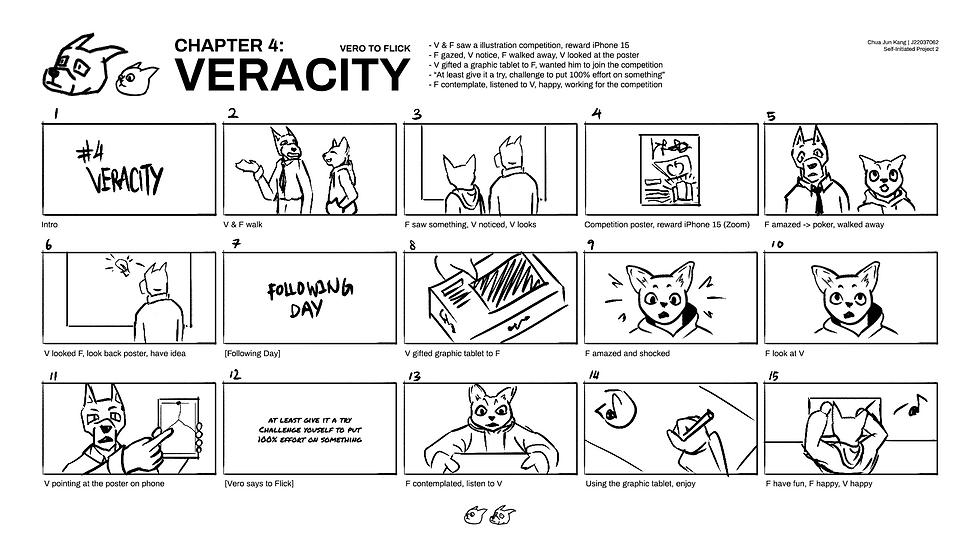

PROCESS
As a first-timer for doing animation, there are a lot of things that I wanted to explore with. For this project, all of the animations were done in Photoshop, because it's raster based which I can create still illustrations with multiple overlays while also animate some of the frames. As I continue deep dive in it, I realize I jumped into a rabbit hole which all of the ideas and illustration need time to animated all of them, due to technical restrictions, tight deadline and multitask on other projects, I'm still able to produce it, but I'll need to cut off some of the things which were planned.






Insights and Reflection
Although the process are very tiring and time consuming, but looking at the outcome of it makes me feel a sense of accomplishment, I’m truly happy for it despite the end result was not what I expected to be, but it’s just the matter of time to continue refining it into what I expected. It consider great as a first-timer.
This semester was the most hectic and hardest semester to me ever. In this round, I didn’t put much second thought into the idea conceptualization or production as I would usually do, I just proceed whatever I had in mind at the moment, it’s considered a new experience to me.
Compared to last project (Evil in Pandora’s Box), this doesn’t have much process to show as most of it were all sketching and illustrating all the frames which is quite repetitive. However, initially I planned to do a whole timelapse for all of this process, but during the process my laptop can’t handle much and keeps rebooting which heavily disrupted my workflow, so I’ve stopped recording it after.
Final Outcome
References
Berger, M. W. (2023, March 6). Does more money correlate with greater happiness? | Penn Today. Penn Today. Retrieved September 3, 2023, from https://penntoday.upenn.edu/news/does-more-money-correlate-greater-happiness-Penn-Princeton-research
Freeman, D. (2015, July 7). How Do Our Levels of Happiness Change as We Age? Psychology Today. Retrieved September 3, 2023, from https://www.psychologytoday.com/us/blog/know-your-mind/201507/how-do-our-levels-happiness-change-we-age
Mahawar, S. (2022, January 11). Causes of crime. iPleaders. Retrieved September 3, 2023, from https://blog.ipleaders.in/causes-of-crime/
MyVita Wellness Institute. (2019). 8 ways to Find True Happiness -. Retrieved September 3, 2023, from https://www.myvitawellness.com/8-ways-find-true-happiness/
Psychology Today. (n.d.). Happiness Over the Lifespan. Psychology Today. Retrieved September 3, 2023, from https://www.psychologytoday.com/us/basics/happiness/happiness-over-the-lifespan
Travers, M. (2020, March 5). Does Happiness Decline With Age? Psychology Today. Retrieved September 3, 2023, from https://www.psychologytoday.com/us/blog/social-instincts/202003/does-happiness-decline-age
Wooll, M. (2022, July 14). Purpose vs. Passion: Finding Both Can Change Your Life. BetterUp. Retrieved September 3, 2023, from https://www.betterup.com/blog/purpose-vs-passion
![Wabi-Sa[Banya] — Live-Client Project 2 (RPR)](https://static.wixstatic.com/media/c6907a_f27acc4cb1bf410fb690e5e1e7b33f35~mv2.jpg/v1/fill/w_980,h_653,al_c,q_85,usm_0.66_1.00_0.01,enc_avif,quality_auto/c6907a_f27acc4cb1bf410fb690e5e1e7b33f35~mv2.jpg)


Comments