


Critical Context Part 1
- May 22, 2023
- 5 min read
Updated: Jul 8, 2023
At this stage of my study, it is a self-exploration that are are looking for an in-depth inquiry, which focuses on the particular rather than the general. The critical context draw on the methods and processes I've encountered throughout the first semester.

Source Quentin Deronzier
1. Do you have your own take on a particular subject? Whether you’d like to make something more funny, sad, happy, or angry – what new emotions or ways of telling a story can you inject into an existing idea or theme? |
Refer back from my statement of intent, I've included frustration as the particular subject that I intended to explore. However, I've considered two ways to express it and have some rough ideation of each tone of voice:
Satirical & Humorous Small matters, Big assumptions—The idea came from the intrusive or inner thoughts and feelings while being in the state of frustration because of daily small matters. The imagination of being powerful and unstoppable to correct things that seems incorrect based on our perspective, values or beliefs. But the reality is, we are powerless to do anything due to the restriction of personal cultivation, morality and interpersonal relationship. There are many situations were like that and I'm interested to compile them and express it
Exaggerated & Dark Life gives me lemons, I leave them aside until it rots—Referring to a proverbial phrase used to encourage optimism and a positive can-do attitude in the face of adversity or misfortune: "When life gives you lemons, make lemonade". Lemons suggest sourness or difficulty in life; making lemonade is turning them into something positive or desirable. However, the idea is contradicted to the original meaning, literally means that I choose not to turn the difficulty in life into sometime positive or desirable, but leave it aside until the rotten mold spreads back to me until they screwed me up. It is a metaphor of bearing hardships, obstacles, problems of life until it becomes unbearable and consumed my remaining consciousness to maintain my calmness. Represents how these aspects can lead to a gradual breakdown and it is alright to let the emotions out as long as it doesn't not harm anyone, verbally or physically.
2. Do you recognize and follow artists who are taking a new spin on similar themes through their work? Name them and write out why you’re drawn to them. |
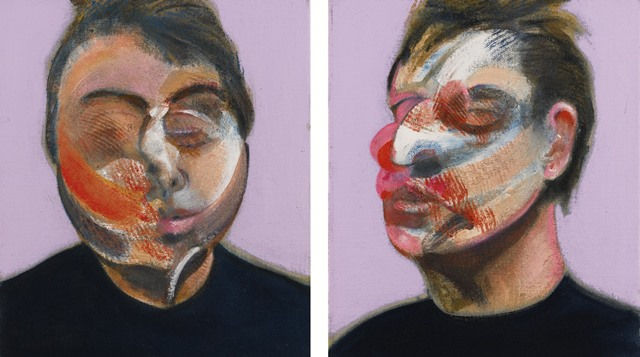
Francis Bacon, Two Studies for a Self-Portrait (1970).
Photo: courtesy Sotheby’s.
1. Francis Bacon
As an artist that emerged in the aftermath of World War II, Francis Bacon explored feelings like pain, fear, and anger in his paintings. It was his intention to create art that reflected raw and honest emotion. His intense, grotesque style portrayed animal-like forms that veered on the alien, as well as distressed human figures often screaming in pain or horror.
I like the fact that his use of unsettling imagery like raw meat, the crucifixion, blood, and biomorphs drew mixed attention and solidified Bacon as a leading post-war painter. The prolific artist often focused on one subject for long periods of time and regularly utilized triptych and diptych formats for his paintings—often to portray an array of shifting motifs. Among his series were portrayals of the crucifixion and screaming popes. In short, he translates the emotion of pain, fear and anger into anguish, emphasizing the emotion

Source: Twitter
2. Domics
Dominic Panganiban (born 27 September 1990), better known online as Domics, is a Filipino YouTuber, animator, and cartoonist. He produced a plethora of anecdotal animations pertaining to the many bothers of life that he has both fortunately and unfortunately experienced. He uses humorous storytelling and animation method to translate his unfortunate experiences into something that are memorable or provide a lesson/value to his audience.
In his ‘Anger’ video, he mentioned— ”In my life experiences, nothing good has ever come from reacting with anger. Of course, everyone is entitled to feel mad or offended by things but to act upon anger and seek destruction leads to no benefits. Even if acting with anger seems like it solved the issue at hand, I realized it would have been handled better without it.”. However, later in the video he also shares that "You should avoid being angry because on the rare occasion that you do, it's much more effective". I’ve drawn to the fact that he translates his personal experiences into a comedy animation video, sharing lessons he learned from each occasion along with a few humorous facts.

Source: Filthy Frank Wiki
3. Filthy Frank Dr. Filthy Francis or Francis of the Filth, simply known as Filthy Frank, was the titular protagonist of the TVFilthyFrank YouTube channel and was known for offensive, shocking, alternative, and filthy humor. Filming himself, his friends, and the bizarre entities living in his house, Frank became the star of his own show: The Filthy Frank Show. An internet comedian, vlogger, Chef, musician, satirist, and absolute madman, Filthy Frank was the edgiest man on the internet. He was described as the literal embodiment of "everything a person should not be". “You know, a lot of people today are saying that this generation of kids are in fact are the stupidest. Now that's debatable. Now I believe there have always been stupid people. But the internet provides greater opportunity for stupidity to be expressed and paraded. In this day and age with the internet, ignorance is a choice! AND THEY'RE STILL CHOOSING IGNORANCE.” --Frank sharing his wisdom on the types of people on the internet in his “Types of People on the Internet” video. Although Frank’s content was defined by its stunning profanity and purposeful ignorance of all things taboo — he indulged in shock comedy that included racial stereotypes, unflinchingly gross food-related videos and a macrocosm of Filthy Frank lore. It’s a persona played by George Miller who translates bad anger, stupidity, humor and stereotypes into a satirical character.
Revisit the 10 annotated bibliographies, and pick 5 which are most relevant to the context of your research. (Refer to your statement of intent) |
1st Version (Initial)
Wilkowski, B. M., & Robinson, M. D. (2010). The anatomy of anger: An integrative cognitive model of trait anger and reactive aggression. Journal of Personality, 78(1), 9-38. doi:10.1111/j.1467-6494.2009.00607.x
The article presents an integrative cognitive model, according to which individual differences in 3 cognitive processes jointly contribute to a person’s level of trait anger and reactive aggression. The researchers concluded with a discussion of the wider implications of this model, including its unique predictions, its relation to motivational factors, and its implications for understanding and treating anger-related social problems by reviewing other literature. The authors conclude with a discussion of important future directions, including how the proposed model can be further verified, broadened to take into account motivational factors, and applied to help understand anger-related social problems.
Yang, J.-S., & Hung, H. V. (2014). Emotions as Constraining and Facilitating Factors for Creativity: Companionate Love and Anger. Creativity and Innovation Management, 24(2), 217–230. doi:10.1111/caim.12089
The article explores the effects of two common specific emotions elicited in work team processes, anger and companionate love, on individual creativity, with the cognitive activation and the functions-of-emotions perspectives. The results from their experiment demonstrate that positive emotions can constrain and negative emotions can foster creative performance. More specifically, they found that companionate love constrains creativity, whereas anger facilitates it. Furthermore, their qualitative analyses of interviews with employees justify the implications of the experimental results in an organizational context. The article suggests that nurturing a moderate degree of hostility towards opposing ideas from others in an idea-generation process while concurrently encouraging thoughtfulness in an idea-implementation process can facilitate managing organizational innovation processes. The article is a good resource for me to understand more about how anger can be a source of motivation for creativity.
Alia-Klein N, Gan G, Gilam G, Bezek J, Bruno A, Denson TF, Hendler T, Lowe L, Mariotti V, Muscatello MR, Palumbo S, Pellegrini S, Pietrini P, Rizzo A, Verona E, The feeling of anger: from brain networks to linguistic expressions, Neuroscience and Biobehavioral Reviews (2019), doi: https://doi.org/10.1016/j.neubiorev.2019.12.002
This article review of the neuroscience of anger is part of The Human Affectome Project, where we attempt to map anger and its components (i.e., physiological, cognitive, experiential) to the neuroscience literature (i.e., genetic markers, functional imaging of the human brain networks) and to linguistic expressions used to describe anger feelings. Given the ubiquity of anger in both its normative and chronic states, specific language is used in humans to express states of anger. Following a review of the neuroscience literature, we explore the language that is used to convey angry feelings, as well as metaphors reflecting inner states of anger experience. The article discusses whether these linguistic expressions can be mapped onto the neural circuits during anger experience and to distinct components of anger. It also identifies relationships between anger components, brain networks, and other affective research relevant to motivational states of dominance and basic needs for safety. This article is useful supplementary information for my research on anger.
Johnson, G., & Connelly, S. (2014). Negative emotions in informal feedback: The benefits of disappointment and drawbacks of anger. Human Relations, 67(10), 1265–1290. https://doi.org/10.1177/0018726714532856
This article uses the emotions as social information (EASI) model and investigated the emotional, attitudinal and behavioural reactions to failure feedback by manipulating negative emotional displays (anger, disappointment or none) and the position level and relational distance of the feedback source. 260 undergraduate students responded to an organizational failure feedback vignette. Results demonstrated that guilt was the complementary emotional experience following displays of disappointment, while reciprocal anger followed displays of anger. These emotional reactions served as important mediators between the emotional displays paired with the feedback message and participant responses of social behaviours, creative task performance and perceptions of the feedback source. The article indicated that negative emotions can have positive organizational and interpersonal outcomes. Guilt in response to disappointed displays resulted in beneficial behaviours and attitudes, while anger in response to angry displays was socially detrimental. The emotion displayed during feedback provision also served as a consistent contextual factor that did not interact with the position level or relational distance of the feedback source to impact behavioural and attitudinal reactions. Overall, this study indicates that discrete negative emotions have unique social-functional properties that require further investigation.
Chazelle, D. (Director). (2014). Whiplash [Film]. Sony Pictures Classics. (2014). Bold Films, Blumhouse Productions & Right of Way Films.
The film portrays the intense relationship between a young jazz drummer student and his demanding instructor equally known for his teaching talents and for his terrifying methods, who leads the top jazz ensemble in the school. The film delves into themes of ambition, perfectionism, and the role of frustration and anger in the pursuit of artistic excellence. It explores the complex dynamics between mentorship, discipline, and creative drive. The film highlights the dark side of the road to greatness. It perfectly portrays the “obsessed artist” trope in a way that is both unique and a little disturbing. The translation of frustration and anger in the film is a useful source for my research.
2nd Version (Correction)
Watt Smith, T. (2016). The Book of Human Emotions: An Encyclopedia of Feeling from Anger to Wanderlust. Profile Books.
The book presents a comprehensive exploration of 156 emotions, ranging from familiar to rare. Drawing on various disciplines such as history, anthropology, science, art, literature, music, and popular culture, the book delves into the stories behind each emotion and examines the diverse influences that shape our internal worlds. This book provides a delightful and thought-provoking read by uncovering hidden feelings, discussing the origins of boredom and confidence, and offering unexpected insights into the human emotional experience. The book challenges Descartes' notion of six basic emotions and emphasizes the need for a broader vocabulary to capture the breadth and depth of human experience. The author brings a unique perspective to identifying and understanding emotions, highlighting the role of words in contextualizing and expressing them. Noteworthy sections include a contemplation of compassion as both a vulnerable and complex emotion, as well as an analysis of contempt as a performative emotion that incites dialogue. The universal nature of disgust is also explored, with a focus on the triggers that elicit this instantaneous and involuntary response. Its vivid descriptions of emotions, previously experienced but unnamed, may inspire artistic endeavours to capture these elusive states of being. Overall, this book helps us understand the complex landscape of human emotions, shedding light on our shared experiences and celebrating the multitude of feelings that shape our lives.
Kaufman, S. B., & Gregoire, C. (2015). Wired to Create: Unraveling the Mysteries of the Creative Mind. Perigee Books.
The book explores the elusive nature of creativity through the authors' research and insights. Drawing from neuroscience and psychology, as well as examples of renowned artists and innovators, the book examines the habits and attributes that foster creative thinking. It delves into paradoxes such as mindfulness and daydreaming, seriousness and play, and solitude and collaboration, demonstrating how embracing these contradictions can unlock deep creativity. Each chapter focuses on a specific attribute or habit of highly creative individuals, including imaginative play, passion, daydreaming, solitude, intuition, openness to experience, mindfulness, sensitivity, turning adversity into advantage, and thinking differently. By showcasing the lives and works of creative luminaries such as Pablo Picasso, Frida Kahlo, and John Lennon, the book offers insights into the intricacies of creativity and provides guidance on enriching this essential aspect of life. This book explores the science of creativity and touches on various emotional aspects, including how negative emotions like anger and frustration can be channelled to enhance creative output.
Yang, J.-S., & Hung, H. V. (2014). Emotions as Constraining and Facilitating Factors for Creativity: Companionate Love and Anger. Creativity and Innovation Management, 24(2), 217–230. doi:10.1111/caim.12089
The article explores the effects of two common specific emotions elicited in work team processes, anger and companionate love, on individual creativity, with the cognitive activation and the functions-of-emotions perspectives. The results from their experiment demonstrate that positive emotions can constrain and negative emotions can foster creative performance. More specifically, they found that companionate love constrains creativity, whereas anger facilitates it. Furthermore, their qualitative analyses of interviews with employees justify the implications of the experimental results in an organizational context. The article suggests that nurturing a moderate degree of hostility towards opposing ideas from others in an idea-generation process while concurrently encouraging thoughtfulness in an idea-implementation process can facilitate managing organizational innovation processes. The article provides a good in-depth insight for me to understand more about how anger can be a source of motivation for creativity.
Klanten, R., Ehmann, S., & Schulze, F. (Eds.). (2011). Visual Storytelling: Inspiring a New Visual Language. Gestalten.
The book explores the emergence of a new visual language that combines information graphics, illustration, and tactile design. As data collection expands and information becomes more accessible, the challenge lies in extracting valuable news, surprising findings, and relevant stories from the overwhelming amount of available information. A new generation of designers, illustrators, and data journalists is tackling this challenge by developing innovative visual forms for depicting information through visual storytelling. Visual storytelling involves using familiar image contexts in new ways to create associations and visualize abstract correlations in an easily understandable and aesthetically pleasing manner. The book showcases a collection of inspiring, insightful, interactive, and entertaining examples that demonstrate how the contextualization of information is pushing the boundaries of contemporary design and aesthetics. Visual storytelling finds applications in various fields such as newspapers, magazines, websites, advertising, business reports, and museums.
Anderson, G., & Heller, S. (2016). The Graphic Design Idea Book: Inspiration from 50 Masters. Laurence King Publishing.
The book serves as an introductory guide to the key elements of good design, exploring topics such as form, narrative, colour, type and image, ornament, simplicity, and wit and humour. It showcases the works of renowned designers to illustrate technical points and inspire readers to explore new ideas. The review highlights the book's thematic approach, featuring artwork and styles grouped together under various concepts. Each concept is accompanied by commentary and illustrations that exemplify the idea. The book is described as a user-friendly introduction to graphic design, providing clear prose and well-paired illustrations. This book showcases the work of influential graphic designers and provides inspiration on how they have used various design elements, including texture, to communicate emotions and messages effectively. It is recommended for individuals interested in understanding the application of artwork for commercial purposes and those seeking a survey of graphic art over the past century.
Reason of correction: The annotated bibliographies can assist to shape up an ideation or conceptualization of a project with more supporting evidence and solidify the context of the project, it does not only limited to the research of the particular subject, it can include a few design bibliographies which helps to structure the project deliverables. (This also affect the point for Q4 as well)
4. How are these resources important to your specific question/ research context? |
1st Version (Initial)
These resources help to shape the direction of my project and solidify my points and perspective by understand the following key points:
The region of the human brain processes anger and links it to our aggression toward internal or external factors.
The interrelation with other emotions such as fear, disappointment, guilt and grief.
The anger arousal cycle/stages of anger
The importance of anger in daily lives and survival
The advantage of converting our anger into motivational and creative sources
The translation and representation of anger from different artists
2nd Version (Correction)
These resources help to shape the direction of my project and solidify my points and perspective by understand the following key points:
Understand the complex landscape of human emotions, illuminating our collective experiences and embracing the diverse range of feelings that influence our lives.
Explores different emotional facets, such as redirecting negative emotions like anger and frustration to boost creative productivity.
The boundaries of modern design and aesthetics are pushed by the contextualization of information
Effectively convey emotions and messages through different design elements, particularly through the utilization of texture.

![Wabi-Sa[Banya] — Live-Client Project 2 (RPR)](https://static.wixstatic.com/media/c6907a_f27acc4cb1bf410fb690e5e1e7b33f35~mv2.jpg/v1/fill/w_980,h_653,al_c,q_85,usm_0.66_1.00_0.01,enc_avif,quality_auto/c6907a_f27acc4cb1bf410fb690e5e1e7b33f35~mv2.jpg)

Comments