


BLOX — Live-Client Project (RPR)
- Jul 8, 2023
- 6 min read
Logo Design for Mooresome Enterprise's —BLOX

Overview
Mooresome Enterprise is a Malaysia company specializing in Web 3.0, Blockchain, and Cryptocurrency services. Their vision is to power decentralized solutions for a connected world and believe they are the only player, as they know, currently in the market. They wanted to create a brand identity logo for the company called BLOX. The logo should convey a sense of professionalism, reliability, security, and trust.
Objective
The main objective of this project is to develop a logo that represents BLOX's brand identity and communicates its brand values of professionalism, reliability, security, and trust. The logo should also be simple, clean and minimalistic with a sense of techy and young, correlated to their target audience.
Design Requirements
The logo should include the brand name BLOX.
The logo should have a professional tone and convey a sense of reliability, security, and trust.
The logo colour should have a techy and young feel to appeal to the target audience.
The overall design should be simple and clean, with a minimalistic element that represents Web 3.0 or blockchain.
The logo should be unique and distinctive in the sense that has high recognition and is memorable will stick in people's minds and create a lasting impression that can lead to brand recognition and customer loyalty.
Brief
Mooresome Enterprise is a Malaysia company specializing in Web 3.0, Blockchain, and Cryptocurrency services. Their vision is to power decentralized solutions for a connected world and believe they are the only player, as they know, currently in the market. They wanted to create a brand identity logo for the company called BLOX. The logo should convey a sense of professionalism, reliability, security, and trust.
Web 3.0 is the next generation of the internet, also known as the decentralized web. It is a more advanced and intelligent web that will rely on new technologies like blockchain and artificial intelligence (AI) to provide a more secure and efficient user experience. Web 3.0 will enable greater privacy and autonomy, enabling users to own and control their data and digital assets. The most common technology in Web 3.0 is blockchain and cryptocurrency:
Blockchain Blockchain is a decentralized, distributed ledger technology that is used to record transactions across many computers. It uses cryptography to ensure the security and immutability of the data, making it nearly impossible to tamper with or hack. Blockchain technology has many potential use cases beyond cryptocurrencies, such as supply chain management, identity verification, and digital voting.
Cryptocurrency Cryptocurrency is a digital or virtual currency that uses cryptography to secure and verify transactions and to control the creation of new units. It is decentralized (based on blockchain technology), meaning that it is not controlled by any government or financial institution, and operates independently of central banks. Cryptocurrencies have gained popularity as an alternative to traditional currencies and have become a popular investment option for many people.

Logo Design Language in This Field
Geometric shapes: Clean, sharp-edged shapes and patterns are often used to represent the precision and order of blockchain technology
Bold typography: San-serif fonts with thick strokes and sharp angles are commonly used to create a strong, modern impression
Minimalism: Simple, clean designs with a focus on white space and minimalistic elements reflect the decentralized and streamlined nature of Web 3.0 and Blockchain
Techy colour palettes: Bright, vibrant colours and neon colours are used to create a futuristic, high-tech vibe
Symbols and icons: Iconography is commonly used to represent complex concepts, such as cryptocurrencies, blockchain technology, and decentralization, in a simple and intuitive way

Target Audience
The target audience for BLOX is individuals and businesses who are interested in Web 3.0, blockchain, and cryptocurrency. These are tech-savvy and forward-thinking people who are looking for decentralized solutions for their digital needs.
Deliverables
A logo design
A branding style guide
Timeline
The overall project is expected to be completed in a one-month duration, the project will be split into two sections: logo development & brand guideline development. Both sections of the project are expected to take approximately two weeks to complete. However, it depends on client satisfaction based on the proposed draft and the communication. Here are the scheduled timeline for the project:
Date | Action Plan (Updates) |
5th April | Project Initiation (Logo Ideation Drafting) |
10th April | Sketch Draft |
13th April | Digital Draft |
16th April | 1st Amendment* |
19th April | 2nd Amendment* |
22nd April |
|
25th April | Brand Guideline 30% Progress |
1st May | Brand Guideline 50% Progress |
5th May | Brand Guideline 100& Progress |
7th May | Project Warp Up |
Resources
1. Russo, C. (2020). The Infinite Machine: How an Army of Crypto-hackers is Building the Next Internet with Ethereum. HarperBusiness.
The book introduces the true story of the rise of Ethereum, the second-biggest digital asset in the world, the growth of cryptocurrency, and the future of the internet as we know it. The book explores the ingenious idea of Vitalik Buterin unfolding Ethereum’s chaotic beginnings. It then explores the brilliant innovation and reckless greed the platform—an infinitely adaptable foundation for experimentation and new applications—has unleashed and the consequences that resulted as the frenzy surrounding it grew: increased regulatory scrutiny, incipient Wall Street interest, and the founding team’s effort to get the Ethereum platform to scale so it can eventually be accessible to the masses. The author details the wild and often hapless adventures of a team of hippy-anarchists, reluctantly led by an ambivalent visionary, and lays out how this new foundation for the internet will spur both transformation and fraud—turning some into millionaires and others into felons—and revolutionize our ideas about money.
2. Bashir, I. (2017). Mastering Blockchain: Distributed Ledgers, Decentralization and Smart Contracts Explained. Packt Publishing.
This book begins with the technical foundations of blockchain technology, teaching the fundamentals of distributed systems, cryptography and how it keeps data secure. The book explores the mechanisms behind cryptocurrencies and how to develop applications using Ethereum, a decentralized virtual machine. The book also explores different other blockchain solutions and get an introduction to business blockchain frameworks under Hyperledger, a collaborative effort for the advancement of blockchain technologies hosted by the Linux Foundation. The book shows how to implement blockchain solutions beyond currencies, the Internet of Things with blockchain, blockchain scalability, and the future scope of this fascinating and powerful technology.
3. Drescher, D. (2017). Blockchain Basics: A Non-Technical Introduction in 25 Steps. Apress.
The book shows the basics of blockchain technology in 25 concise steps. It does not use any mathematical formulas, program code, or computer science jargon, it does not require any previous knowledge of computer science, mathematics, programming, or cryptography. Terminology is explained through pictures, analogies, and metaphors. This book bridges the gap that exists between purely technical books about the blockchain and purely business-focused books. It does so by explaining both the technical concepts that make up the blockchain and their role in business-relevant applications. This book covers the meaning, importance, potential, major components and each of their purpose, the limitations, existence and application scenarios of blockchain. This book provides a general idea of what blockchain technology is, how it works, and how it will potentially change the financial system as we know it.
4. Voshmgir, S. (2019). Token Economy: How Blockchains and Smart Contracts Revolutionize the Economy. BlockchainHub.
The book refers to cryptocurrencies as tokens and explains that the term “token” is the more accurate term, as many of the tokens have never been designed with the purpose of representing a currency. However, since tokens do have similarities to fiat currencies, the role of money as a medium of exchange is analyzed at length in this book. This book gives an overview of the mechanisms and state of blockchain, the socio-economic implications of tokens, and deep dives into selected tokens use cases: Basic Attention Token, Steemit, Token Curated Registries, Purpose Driven Tokens, Stable Tokens, Asset Tokens, Fractional Ownership Tokens, Libra & Calibra (Facebook), and many more.
5. Rajiv & Lal, Manohar. (2010). Web 3.0 in Education & Research. BVICAM's International Journal of Information Technology (BIJIT) ISSN 0973-5658. 3. 6.
The article highlights the continuous evolution of the Internet and its impact on web-based education and learning. It traces the progression from Web 1.0, a read-only medium, to Web 2.0, a read/write platform, and finally to the currently emerging Web 3.0, which combines reading, writing, executing, and machine-based thinking capabilities. Web 2.0 and Web 3.0 have introduced new tools and technologies that have transformed web-based education. The article begins by discussing various definitions of Web 3.0, its evolution, and its key characteristics. It then delves into the potential future technologies, trends, tools, and services associated with Web 3.0. Specifically, it explores their potential in enhancing online learning, enabling personalization, and facilitate knowledge construction, all driven by the Semantic Web. Overall, the article provides insights into the advancements in web-based education and the potential of Web 3.0 technologies to revolutionize online learning experiences. It serves as a valuable resource for individuals interested in understanding the role of the evolving web in education and the possibilities offered by Web 3.0.
6. Goel, A. K., Bakshi, R., & Agrawal, K. K. (2022). Web 3.0 and Decentralized Applications. The 2nd International Conference on Innovative Research in Renewable Energy Technologies (IRRET 2022). https://doi.org/10.3390/materproc2022010008
This article explores the evolution of the web from its inception in the 1990s to the present day. It outlines the different iterations of the web, starting with the static read-only Web 1.0, followed by the interactive Social Web or Web 2.0 that allowed users to engage and contribute content. The focus then shifts to Web 3.0, which represents an unmediated read-write web and a decentralized internet. The article provides a concise overview of the journey from Web 1.0 to Web 2.0 and further onto Web 3.0. It emphasizes the emergence of new technologies and their impact on the evolving nature of the web. The paper also hints at future possibilities that may arise with the continued development of Web 3.0 and the adoption of emerging technologies. This resource offers valuable insights into the evolution of the web and its potential future directions. It is a useful reference for individuals seeking an understanding of the transformative changes that have occurred in web technology and the prospects that lie ahead with Web 3.0 and emerging technologies.
7. Chohan, Usman W., Web 3.0: The Future Architecture of the Internet? (February 7, 2022). Available at SSRN: https://ssrn.com/abstract=4037693 or http://dx.doi.org/10.2139/ssrn.4037693
This article delves into the concept of Web 3.0 as a transformative iteration of the World Wide Web. It compares the previous iterations of the web, where users were limited to a read-only role in Web 1.0 and became content creators within the confines of oligopolistic entities in Web 2.0. In contrast, Web 3.0 envisions a decentralized internet architecture where users hold the ultimate power as arbiters and primary agents of value creation and exchange. To achieve this decentralized ownership, proponents of Web 3.0 advocate for a blockchain-oriented restructuring of the Internet. The paper aims to critically evaluate the potential merits of this decentralized manifestation of the Internet through social, economic, and cultural lenses. This resource offers an in-depth analysis of the concept of Web 3.0 and its implications. It engages with the socio-economic and cultural aspects of a decentralized internet and presents a critical assessment of its viability. The article serves as a valuable reference for individuals interested in understanding the opportunities and challenges associated with Web 3.0's decentralized vision.
8. Airey, D. (2015). Logo Design Love: A Guide to Creating Iconic Brand Identities. New Riders.
The book delves into the world of creating iconic brand identities. Through captivating client case studies from renowned designers, I explore the entire process from inception to completion. The book provides valuable insights into how designers craft effective briefs, generate brilliant ideas, determine fair pricing for their work, and foster fruitful collaborations with clients. The book also includes the author's personal experiences working on his own identity projects including sketches and final results of his own successful designs. The author also uses the work of many well-known designers such as Paula Scher, who designed the logos for Citi and Microsoft Windows, and Lindon Leader, creator of the current FedEx identity, as well as work from leading design studios, including Moving Brands, Pentagram, MetaDesign, Sagmeister & Walsh, and many more.
9. Wheeler, A. (2017). Designing Brand Identity: An Essential Guide for the Whole Branding Team. Wiley.
The book provides an invaluable resource for individuals involved in rebranding projects or seeking to educate others about the essentials of branding. This comprehensive book covers a wide range of topics, including brand research, strategy, design execution, launch, and governance. It serves as a compendium of tools and best practices, offering inspiration and guidance for achieving branding success. The book is divided into three main sections: brand fundamentals, process basics, and case studies. Within these sections, readers will find over 100 subjects related to branding, accompanied by checklists, tools, and diagrams to aid in understanding and implementation. Additionally, there are 50 case studies that delve into the goals, processes, strategies, solutions, and results of various branding projects. The book also features over 700 illustrations showcasing different brand touchpoints, allowing readers to visualize how brands come to life across various mediums. Furthermore, it includes more than 400 quotes from branding experts, CEOs, and design gurus, adding valuable insights and perspectives throughout the narrative. The book is an invaluable resource for understanding and implementing effective branding strategies.
10. Müller, J., & Remington, R. R. (2015). Logo Modernism (J. Müller, R. R. Remington, & J. Wiedemann, Eds.; U. Wulfekamp, Trans.). Taschen.
The book is a comprehensive catalogue of the history of modern logo design. Presented in large format, revealing how modernist principles shaped corporate identity during this time. From media organizations to retail giants, airlines to art galleries, the book presents a sweeping survey categorized into three design-oriented chapters: Geometric, Effect, and Typographic. Each chapter further delves into specific form and style sections, such as alphabet, overlay, dots, and squares. The book also explores the intersection of modernism and graphic design. The book features eight designer profiles and instructive case studies, highlighting the lives and works. This book stands as an essential reference for anyone seeking to explore and understand the impact of modernist graphic design on visual communication, capturing the interest of those fascinated by social, cultural, and corporate history, as well as the persuasive power of imagery and form.
Process
1. Logo Questionnaire

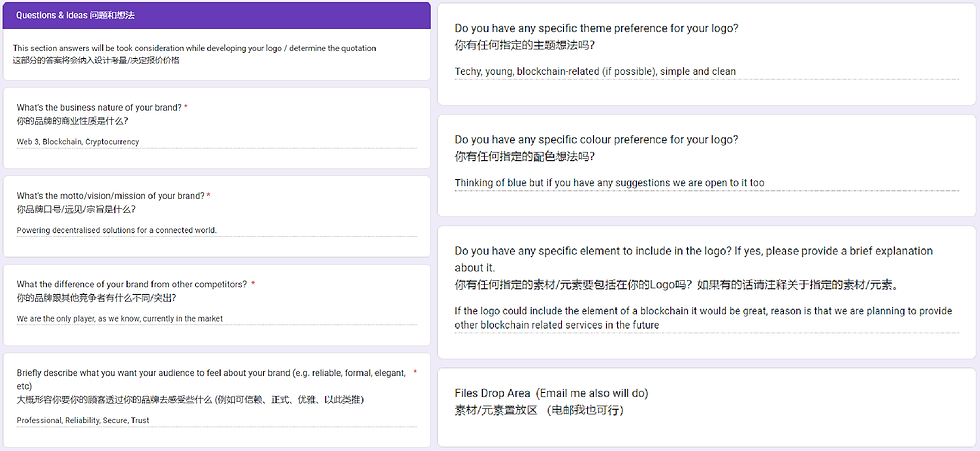
The client contacted me personally and requested my availability and an approximate time duration for the overall process to develop a logo. After they had agreed on my availability and the time duration taken for the process, I requested them to fill in the logo questionnaire that I've created for all my logo freelance projects.
The questionnaire is to let me know further about the nature of their business, motto/vision/mission and the unique selling point of their business brand. The questionnaire also shows what kind of mood and style that the client wanted to portray in their brand logo. However, these are all the points from the questionnaire in this live-client project:
Specialize in Web 3.0, Blockchain and Cryptocurrency
The brand motto is "Powering decentralized solutions for a connected world"
USP is they are the only player, as they know, currently in the market
Wants the audience to perceive the brand as a professional, reliability, secure brand
Logo theme should include techy, young, blockchain related (if possible), simple and clean
Logo colour preferences primarily is blue, and also based on my suggestions
The element of the logo is best to include blockchain
Besides, they also provided a drive link which include all the references
2. Rough Sketches & Client Selection

The first image (upper left) was the sketches I've done personally, the second image (upper right) was the selections of the logo I've picked for the client to choose, along with the description for each logo draft. The client has chose the third, fourth and sixth logo from the selection, which is shown in the image (bottom right).
3. Digital Draft

These are the digital drafts I've created based on the logo sketches selection (first and second row). The client comments the logos are too flat, request to add depths into it and provided a few examples (bottom right).
4. 1st Amendment


These are the amendments shown to the client. Client comments the logos appears too generic, lack high recognition. They like the idea of box, cube and emphasize on the letter B. Provided another example and asked to derive from it. They also fixed on these three colours (last image)
5. 2nd Amendment

These are the second amendments shown to the client. Client ended up with another logo design provided from their end, requested to fix the logo according to golden ratio.
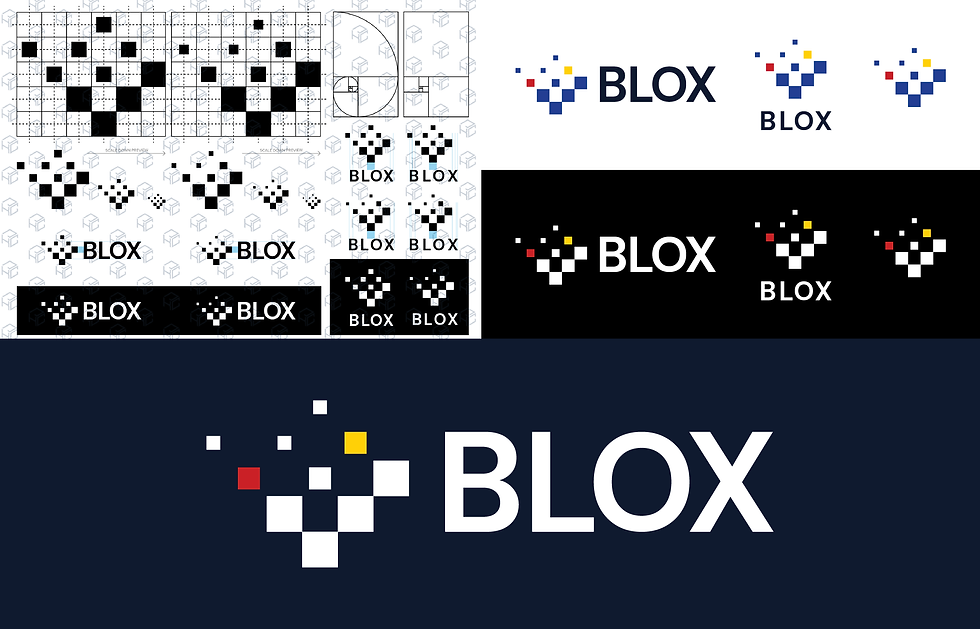
6. Finalized Version

Reflection
It's my first time dealing with a middle person who seems to update with their upper from her end. This middle person is actually an acquaintance of one of classmates in diploma, I was introduced by my classmate to her. Regarding of my knowledge of the brand or the company, I had no clue but knowing that they specialized in Web 3.0, blockchain and cryptocurrency service related due to context needed for the branding design.
This project was deal in 5th of April and complete in 11th of May. According to the scheduled timeline, it has been delayed around two weeks due to pending updates from her upper. The overall communication process has a bit of miscommunication within as it includes two persons opinion which is the middle person and her upper. For example, in the feedback on the digital draft, it was her opinion suggesting that the logo are too flat; but in the feedback on the first amendment, it was the client opinion suggested the logos seems generic and lack distinctive in a sense of high recognition to create lasting impression. And also mentioned "liked the idea of the box, cube and emphasize on the letter B", this should be referred to the initial sketch draft as it have descriptions emphasizing the idea of a block represent the blockchain, and the letter B which represent the initial of their brand.
In terms of workflow, in this case, they didn't choose any options provided as usual but giving feedback based on the overall, it is difficult for me to tell which style or preferences they most likely would prefer because the communication process involved two person which the message transferred person to person could be different, and I've already stated the overall design process beforehand. I have no choice because of the time but only refer to their feedback and make amendments from there. Usually, I would exert my personal opinion to the client, explaining why it is better based on my approach style or design, but in this case, it is difficult because of the Chinese Whisper Effect.

![Wabi-Sa[Banya] — Live-Client Project 2 (RPR)](https://static.wixstatic.com/media/c6907a_f27acc4cb1bf410fb690e5e1e7b33f35~mv2.jpg/v1/fill/w_980,h_653,al_c,q_85,usm_0.66_1.00_0.01,enc_avif,quality_auto/c6907a_f27acc4cb1bf410fb690e5e1e7b33f35~mv2.jpg)

Comments