


Advocacy x Design
- Apr 22, 2022
- 8 min read
Updated: Apr 6, 2023

Advocacy x Design
Advocacy is defined as any action that speaks in favour of, recommends, argues for a cause or policy, supports or defends, or pleads on behalf of others. Advocacy incites that convincing other your cause is a worthy one oftentimes lies in listening to their thoughts, making them aware of yours, and tackling disagreements amicably.
“We all have a responsibility not only to bear witness to what’s happening around us but to play an active role in making this a more just world,” says Chanae Richards, CEO and principal designer of Olọrọ Interiors.

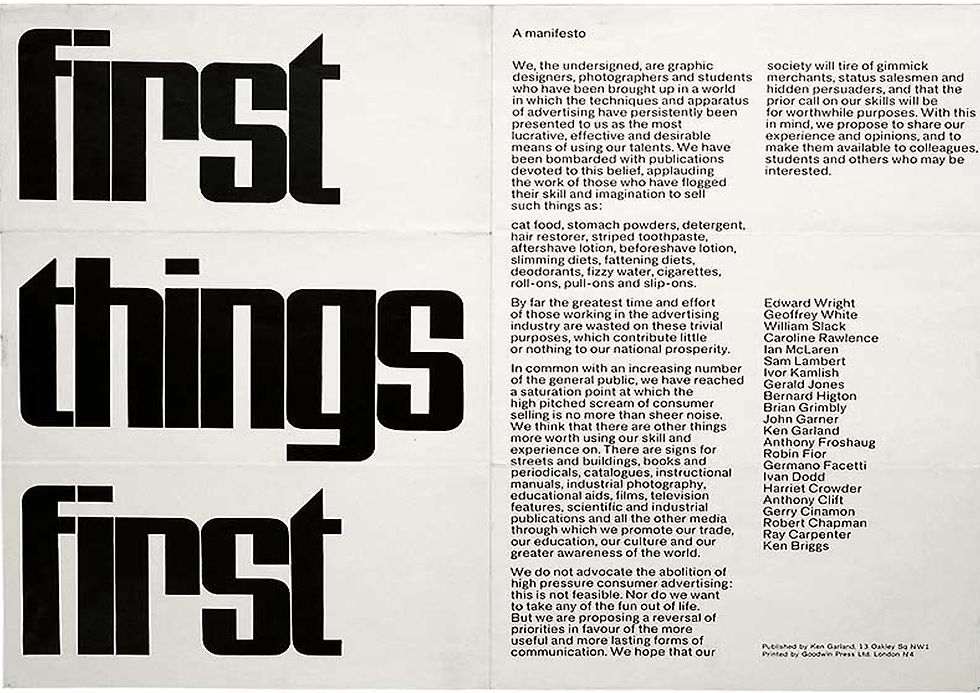
First Things First Manifesto
The First Things First manifesto was written in 1963, published in 1964, by Ken Garland and signed by an additional 21 ‘visual communicators’. It called upon designers to consider their influence and examine alternate uses for their talents as opposed to working tirelessly promoting consumerism. It was later updated and published by Adbusters magazine in 1999 (First Things First Manifesto 2000), Cole Peters in 2014 (First Things First Manifesto 2014), and Namita Dharia and Ben Gaydos in 2020 (First Things First Manifesto 2020).
The manifesto was conceived from the outset as an international initiative in the 2000 edition, broadening its target from advertising to marketing and brand development. In the 2014 edition, the manifesto addressed the new ways in which those with skills in the fields of design and technology are spending too much time working on superficial problems. the manifesto also stated that the industry prioritizes profit over usefulness and isn't particularly focused on solving real problems around education, medicine, privacy, public awareness and other important areas. In the 2020 edition, the manifesto highlight more about the histories of ethics of design, community-based initiatives, non-exploitative social relations, nature as a complex system, and reconnecting design and manufacturing to the Earth and its people.
The design role of the First Things First Manifesto is to stand firm in the values we, designers, are in and use our skills and talents for the well being of certain circumstances. Decentralize the "working tirelessly promoting consumerism" process and open it up to anyone related to the industry.
Hope to Nope Exhibition

Hope to Nope is co-curated by the Design Museum and GraphicDesign&’s Lucienne Roberts and David Shaw, with Rebecca Wright. The idea is the ten years since the global financial crash of 2008 have been especially politically volatile. At the same time, the rise of social media has changed the way graphic political messages are made and disseminated. Traditional media have been joined by social media, with its hashtags and memes – all of which means that the influence and impact of graphic design have never been greater. The exhibition explores the numerous ways graphic messages have challenged, altered and influenced key political moments.
The curators are careful to say that the exhibition takes no particular political line and doesn’t necessarily support any of these causes. Among many other issues and events, it features:
a display case about the anti-capitalist Occupy movement
a wall-sized photo of the women’s marches in Washington, London and elsewhere
a big quilt, a protest video and other artefacts from the Black Lives Matter movement
opposition to Vladimir Putin, especially to his anti-gay policies
opposition to Tory Austerity and Brexit in Britain
opposition to Jacob Zuma’s corrupt regime in South Africa
opposition to the North Korean dictatorship of Kim Jong-un
opposition to the authoritarian Turkish president Recep Tayyip Erdoğan
opposition to Donald Trump

The exhibition is divided into three sections, Power, Protest and Personality, the exhibition demonstrates how each of these 3Ps has been abused, expressed and utilized by the political establishment, the media and grassroots movements through a vivid mix of posters, social media posts, video and much more.
From the hilarious Donald Trump-themed fortune teller machine to the sobering infographics depicting the trajectory of social media’s influence, or the right-wing memes that have gone viral, this exhibition is full of content that anyone living through the last decade can enjoy and relate to.
Examples: Visuals as Vehicle

Obama Hope Poster — Shepard Fairey (2008)
Of all of Fairey’s work, the Hope Poster has had the most influence, exposure and cultural circulation. By employing his street art style, Fairey created a poster that captured a nation. His poster acquires its power from a combination of traditional and modern elements. The poster's success derives from Fairey’s depiction of Obama. The three-quarters pose is a powerful rendering of a potential promising leader and communicates Obama’s sense of leadership, hopefulness and forward-thinking.
Fairey’s choice of colour is a key feature of the design, it provides meaning to the poster and assists in its iconic status. The colour palette used is a salute to the traditional American patriotic colours. The red is slightly more orange, the blue is lighter and grayer in tone and the white resembles more of a cream colour. This colour palette is most commonly associated with Fairey’s style and work. By using “off colours” he is paying homage to the traditional patriotic colour scheme rather than replicating it like almost all mainstream American political campaign images.
“A lot of people were digging Obama, but they didn’t have any way to symbolically show their support. It became very clear quickly that the demand for an image like that had not been supplied and that the Obama supporters were very hungry for it and also very motivated to spread it.”

I Am Not A Virus — Red Hong Yi (2020)
Reminded of her time under lockdown, which Red describes as a ‘flight or fight’ situation, the artist was struck by an urgent need to “change and evolve” right away, so that even if she was grounded in Malaysia and confined within her own room, she was going to change and create regardless.
“We have the internet,” Red declares. “And that’s the most powerful tool we have to break borders right now. I contacted a couple of freelancers while under lockdown and worked with them on a couple of projects; ‘I Am Not A Virus’ being one of them.
“It was a reaction to what was happening around the globe. Because we’re living in such a unique time, it’s basically a significant event that may be one for the books for the generations to come. All sorts of mediums, including art, will have recorded this so we can talk about it with future generations. And that’s the beauty of art, right? I want to break the moulds of art, so to speak, that art doesn’t have to be one or the other. It can be anything really as it’s subjective.”
The project is led by Diversity Arts Australia and is a partnership with the Asian Australian Alliance, Democracy in Colour 4A Centre for Contemporary Asian Art with funding from the Australia Council for the Arts City of Sydney and City of Parramatta.
Kita Semua Penghasut — Fahmi Reza

In late 2015, the Malaysian Prime Minister, Najib Razak was facing widespread accusations of corruption involving a state-owned investment fund known as 1MDB. Billions of dollars were siphoned from this fund which Najib oversees, with US$681 million allegedly transferred into Najib’s personal bank accounts.
But a few months later, in January 2016, the Malaysian Attorney General closed the corruption investigation against Najib, exonerated him of corruption allegations, cleared him of political wrongdoing, and accepted Najib’s claim that the US$681 million was a donation from a Saudi royal family.
A lot of people here were outraged by this announcement. Reza immediately came up with the first graphic of Najib with evil clown make-up and posted the image on my social media accounts on 30th January 2016 as an act of protest against all the bullshit and lies that he used to cover up his corruption that had turned the whole thing into a circus and a joke.
The first poster of the clown came with a scribbled slogan that reads, “Dalam negara yang penuh dengan korupsi, kita semua penghasut” (In a country full of corruption, we are all seditious) which was Reza's response to an Amnesty International report that states that in 2015 alone, the Sedition Act, which is a law that is frequently used by the government to restrict freedom of expression, was used 91 times to arrest, investigate and charge individuals for making comments or actions deemed critical of the government.

Around 40 DIY t-shirt printers all over the country started printing and selling protest t-shirts with the clown graphic along with the slogan “Kita Semua Penghasut”. Within a month they’ve sold a combined total of around 3,000 t-shirts. Kids who bought the t-shirts were enthusiastically sharing selfies of themselves wearing the t-shirt on social media using the hashtag #KitaSemuaPenghasut as a way to express their protest and dissent.
And then there was the guerrilla street art campaign. Kids started downloading the clown graphic and printed them out as stickers and posters. Within a month, 80 wheat-pasted clown posters of different sizes, even as big as 8 feet tall, and hundreds of stickers started popping up on street walls in over 30 cities nationwide.
But the government was not amused. All of these led to Reza's arrest and charges in court.
What I've Learned From it?
Advocate using design as an expression is a powerful tool for the public and it also shows how important the role of design is. It can be influential, cultural circulation or sensational.
The past ten years have seen a particular upsurge in the use of graphics in political protest.
Taking the Hope to Nope exhibition as an example, the exhibition aims to capture, depict, examine and display the political graphic design of a turbulent decade. Alongside traditional posters and banners, the exhibition charts the rise of digital media and social networking, which have given graphic iconography an extraordinary new reach from the year of 2008 to 2018.
Graphic design in the form of internet memes, posters and protest placards is being used by the marginalized and powerful alike to shape political messages like never before. From Fahmi Reza, he created the first poster of the clown came with a scribbled slogan that reads, "Dalam negara yang penuh dengan korupsi, kita semua penghasut" (In a country full of corruption, we are all seditious) as a response to the Sedition Act, the law that is frequently used by the government to restrict freedom of expression. He speared the poster using social media and this action pushed other local graphic designers to produce their own protest posters featuring the slogan “Kita Semua Penghasut” (We are all seditious) with their own version of Najib with clown make-up and flooded the posters on social media. According to Fahmi Reza, there were around 100 posters were produced.
Zulkiflee Anwar Haque or better known as Zunar

The cartoonist that I known before Fahmi Reza was Zunar, the country’s most controversial political cartoonist who had spent the past nine years subject to endless arrests and raids, had nine books banned, was charged under six different laws including nine charges of sedition — which carried a sentence of 43 years in jail — simply for using his pen to critique former prime minister Datuk Seri Najib Razak and his wife, Datin Seri Rosmah Mansor.
“Cartoons and comics are a matter of interpretation. If you don’t agree with the content, no problem. But don’t use your interpretation as a law to ban it,” he declared at that time, remarking bluntly: “Don’t like? Don’t read!”


He took on hard issues and broke them down into simple storylines that most Malaysians identified with. That’s their strength and their vulnerability; and a revealer of something deeper.
He strove to make them less about politics and more about issues that pervaded Malaysians generally. "I related corruption to people’s daily life," he says firmly. "So they cannot say 'corruption is a political issue' anymore. This is your issue. You’re ultimately paying for the corruption."
“Design is multidisciplinary, so it’s fair to tailor how you approach advocacy to suit your work.”
References

Comments